We hardly have enough conversations about the future. Understandably #presentforward wise we are dealing with too much, yet up to 90% of “todays” problems will evaporate in the next 10 years. Short termism is rather natural; if you’ve heard of the marshmallow theory – it’s primal. Add to that generations and years of conditioning, indoctrination, we end being really really myopic.
Hence the rise of the Extreme Empaths or #Xempaths; those that can emanate their purposes >= 2 std deviations out. You need time to think about the future. You need to understand humans to manifest functional design. Art is an expression, design is functional. But design is also a means how we take a sneak peek at multiple realities in the future. It’s a little like astral projection really, not necessarily out of body- but extreme empathy helps define boundaries of probable realities – like Ra’s primeval eyes if you’re adroit with your Egyptian mythology.
Thecurrent cadre of leaders – through no fault of theirs – have been trained/ indoctrinated to think short term, to be ‘efficient’ to cut costs. The org design, management theories of the roaring 60s – 80s has been far too fixated on being ‘lean’ and mean (actually, the latter rears its ugly head far more often!); these professional MANAGERS aren’t what we would intrinsically, authentically call a LEADER (today). Strategy, design, innovation; these are much more synonymous with the definition of the leader of our times -> TOMORROW. Many stories here, I personally love Prof Clay Christensen’s disruptive series (mini mills, Toyota) taking over the world – gradually working their way up (and driving their competition out of the market). There are hard lessons here: the focus on RONA (Return on Net Assets) vs ROX (Return on Experience) or a proxy for FutureBack-thinking. In most of his & student’s work there’s a discussion on the famous great managers of the day e.g. Jack Welch and what he did for GE. It’s an interesting contrast, how GE is faring today – and others like Tesla, NIO, Xpeng disrupting the ICE (Internal Combustion Engine) market – Tesla for example isn’t what’s apparent i.e. an automaker. They’re closer to a battery-maker at the core, but Elon’s dream to go to Mars (space travel?) is their real Purpose. Back to GE: they saved billions – meaning hoarding, cratering Cost of Capital (which is now counterintuitively ‘cheap’ esp in America). Ironically, there aren’t sufficient funding for forward looking, FutureBack innovation – “water, water everywhere – but not a drop to drink!” . GE as I’m sure has been studied to death in business cases, went through through SixSigma, LEAN and other “optimisation” processes. Back in the days, org design, mgmt theories definitely placed Profits before People e.g. reducing the denominator in the RONA equation, laying off thousands along their wake. Good to great, what got us here – definitely 100% won’t get us there. Where’s there? The next normal. Not new, but next. Specifically to thrive, not just survive. Akin to the waxing moon, scaling the current postwar sigmoid S curve is well, akin to playing the finite game. The game’s ending!
The global pandemic really just made us realise how acute the “problem” is – over the years , we’ve neglected what it means to be human; connecting humans has never been more important.
These current hyper low-touch environments, we enter an epoch of the Experience Economy that’s going to see wild swings in valuations (ROX, Experience Equity). Trust is fleeting, comes and goes quickly. Everyone’s ‘impatient’ as one may observe. Our innate need to (re)connect as humans will see the rise of the metaverse, and alongside it Artificial Intelligence. Great thinking by Kaifu-Lee AI2041 on the Ten Visions of the AI Future as the ‘walked the future back’ from 2041.
We are constantly being urged to speed up. Change is happening so fast! The speed of change is accelerating! Change is exponential. Or my fave, “fast is the new fast.” The concept of VUCA (volatile, uncertain, complex, ambiguous) is often invoked to support this need to get faster. It’s good that change and uncertainty are being acknowledged. This is certainly preferable to a head-in-the-sand view that everything is okay, or worse the view that someday things are going to go back to normal, or worse still that we’ll be able to go back to the good ole days (we ain’t).
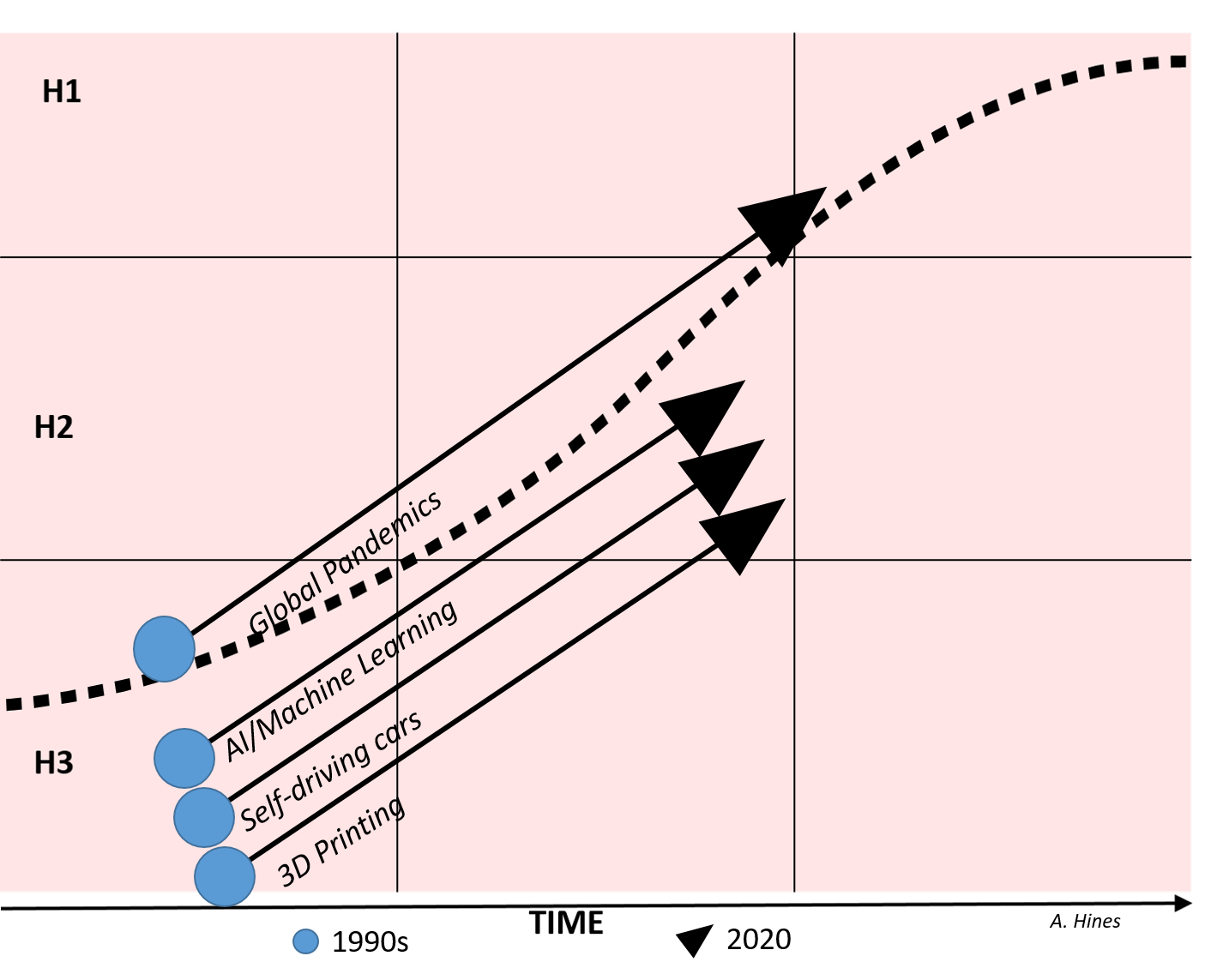
But is change really happening at blazing speed? Only if you’re not looking! Change looks to be happening really fast when we’re not doing our foresight homework. When we do our foresight homework, the sudden disruptions, surprises, bolts out the blue, came out of nowhere stuff goes away, in the sense that we’ve already seen it coming. Let’s take a few examples of “Who could have seen that rapid change coming?”
- Self-driving vehicles: I visited a major automobile manufacturer in the early 1990s to participate in a project on Intelligent Vehicle Highway Systems, aka self-driving cars.
- 3D printing: I wrote a report in the mid-1990s on the future of Desktop Manufacturing, aka 3D printing
- AI/machine learning: I lost track of how many times we wrote about this in the 1990s
- Global pandemics: We wrote about global pandemics in our 2025 book published in 1996
The common denominator here is that if we had been doing our horizon scanning, we would have seen all four of the above coming at least thirty years ago!!! Today’s surprises come to most people’s attention when they are in Horizon 1 or Horizon 2. It typically takes a long, long time for a new development in Horizon 3 to make the journey to H2 and then to H1. And many H3 ideas never do make it. One thing we futurists can practically guarantee is that if you commit to foresight and do your horizon scanning, you will feel more confident about your future, because you know that you will not be surprised. So, do your homework, and take your time in navigating the future.
 The optimism of #Purpose & science of #design in forging #digital customer experiences! Opinions my own!
Leave a comment